
Developer Resources
The Digital Rule of Law provides the legal, technical, and governance bedrock for a trust-based digital economy.
It changes the entire digital economy by fundamentally upgrading the structure of data into an intelligent, environment responsive, self-protecting discrete unit of verifiable value.
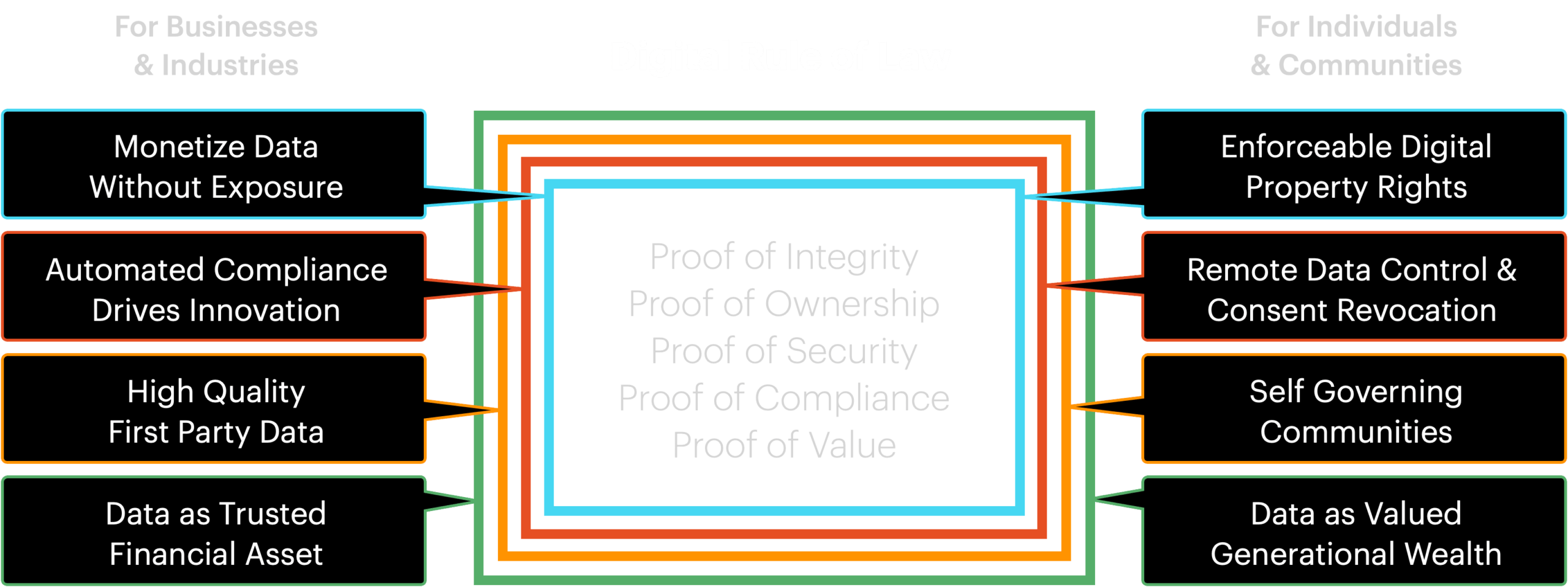
The Digital Rule of Law is composed of several underlying technologies:
TODAQ TWIN API – Hosted TODA Integrity Network
TODA Core – Open-source library & command-line client
TODA Command Line Tools – Command-line interface documentation
TODA JavaScript – JavaScript Libraries for Cryptographic Integrity (NPMJS Package)
TODA Rigging Specification – Cryptographic integrity specification used to implement the TODA Integrity Network in a specific programming language
TODA Documentation (Simple Rigs Hold Fast) – The TODA Integrity Network Distributed Graph Architecture Whitepaper
TODA Publications – TODA Integrity Network Scholarly Articles
TODAQ Micropayment Services
TODAQ Micropay System – Send/receive micropayments to hosted TODAQ Twins
TODA Tech Stack (5 mins)
TODA Primitive Summary (3 mins)
TODA Pong Demo (6 mins)
TODA Integrity Verification (6 mins)
TODA Portable Persona (3 mins)


The Centre for Redecentralisation (CRDC) pursues research projects for creating new technological primitives that expand the types of computational systems that can be built and explores the economic, social, legal and political implications of these new types of systems.
Our intent is to push the frontier of decentralised systems and technologies, providing developers in both research and industry with powerful building materials for creating tools that provide people and their communities with the power to solve their own problems, and create systems that protect the needs of everyone in a digital world.
Redecentralisation is not just about bypassing existing gatekeepers, but solving the difficult problem of providing a foundation for rich interaction in the digital domain without extractive intermediaries.
We are concerned by the strong tendency of the current Internet toward excessive centralization and how a handful of companies are increasingly accumulating data that leads to concentration of wealth and power.
Centre for ReDecentralisation Publications
Fair Exchange: Theory and Practice of Digital Belongings is a 292 page book (World Scientist, Mar 2024) by Carlos, Dann, Hazem and Jon that explains Fair Exchange as a fundamental distributed systems problem and its practical importance is several fields of the digital economy.
The authors show how the use of trusted execution environments (called attestables in the book) can help to engineer decentralised solutions that obviate the need of monolithic trusted third parties.
They also discuss the potencial legal issues that can emerge in practice from the execution of the five basic operations (handshake, deposit, verify, synchronise and release/restore) included in all fair exchange protocols.
Centralization, Decentralization, and Digital Public Infrastructures. In this blog, Jon Crowcroft presents a general (nearly free from computer technicalities) introduction to the topic of centralisation vs decentralisation.
Among other points, he mentions that the role of a central authority (for example, the goverment) in a complex system is to coordinate. He suggests that with the development of digital technologies, coordination needs to be more efficient and not necessarily centralized.
Towards International Governance of AI? This article by Jon Crowcroft and Hazem Danny Nakib is an invitation to ask the right questions about the controversy that Artificial Intelligence (AI) governance has recently generated.
The authors ask, what exactly are governmental and non-governmental authorities concerned about in their discussions about the need to govern and regulate AI.
They also ask, how is governance of AI different from governance of other technologies like nuclear weapons and air traffic. They suggest that the debate about AI should move away from the orthodoxy of owning and controlling to what it means to govern intelligence itself through radical new starting points.
How to Tell When a Digital Technology Is Not Ready for You Jon Crowcroft 2020. To newcomers, it is hard to tell the difference between hype and ready to deliver and between re-branded and genuinily new. Jon has been working on Internet technologies since the inception of the Internet and has seen some technologies (good and bad) stay and others fade. In this 2 page article, Jon shares his wisdom over this question. He uses Blockchains, Machine Learning and Internet of Things as examples to explain his point. Don’t be taken in, ask the right Qs. For example, am I getting the IoT devices + 10 years of software updates?
Redhouse Gases: A manifesto for re-decentralisation is a seminal paper by Jon Crowcroft, Garreth Tyson and Richard Mortier that raises a concern about the strong tendency of the current Internet toward excessive centralisation. They describe how a handful of companies are increasingly accumulating data that leads to concentration of wealth and power.